Compositions from tracey hill on Vimeo.
All the children of Parkvale School have created a special piece of art. Make it a family outing to the exhibition. It is open before school, Monday, Tuesday, Wednesday and Thursday, this week and until 6pm each night.
Showing posts with label Whetu. Show all posts
Showing posts with label Whetu. Show all posts
Sunday, 13 September 2015
Art Exhibition

Wednesday, 2 September 2015
Symmetry and Fractions

We are learning about symmetry and finding a fraction of a set.
We are working really hard at problem-solving and checking our thinking.
We could solve the problems in different ways
- sharing into groups one by one
-sharing into groups by skip counting and then adding some or taking some out of each group eg. 5,10,15, 20 and then put one more into each group so 1/4 of 24=6
-Sharing into groups by using our addition facts eg. 4+4+4=12 so 1/3 is 4


Our problem was...
Butterflies all around the world have different shapes and patterns on their wings but one thing is the same on all butterflies they are symmetrical. What could the butterflies in each problem look like?
 |
| 1/5 of the 20 spots are yellow. Jack skip counted and added a bit more to each group to work it out. |
 |
| 1/5 of the spots are yellow. Whetu and Riley created this symmetrical butterfly. Their butterfly looks very different than Jack's but have both solved the problem. |
 |
| 1/4 of the 24 spots are green. Chahat and Katie used a bar to help them solve the problem. They broke the bar into 4 groups and worked out how many would be in each group by skip counting in 5s and then adding 1 more into each group. |
 |
| Erin and Nevaeh used skip counting to find 1/3 of 30. 1/3 of the 30 spots are pink. |
Thursday, 27 August 2015
Marching
Every Wednesday and Thursday Miss Stacey comes to Parkvale to teach us marching.
We are learning that marching is quite tricky but a lot of fun. We need to have lots of discipline because everyone in a marching team has a job to do to stay together, in line and in a block.
We always lead with our left foot and start each step on the back of our foot. We have to listen to the music very carefully to hear the beat and step with our left foot on each beat.


To help us stay in line, Miss Stacey uses callipers with chalk to measure our length of pace (the gap between each of our steps). She puts a chalk mark on the concrete to help us know where to stand.

We are learning lots of new marching vocabulary;
Handgrips means keeping our hands closed and at our side
Covering means to stay in line with person in front of you
Dressing means staying in line with the person next to you
Block means a group of marchers standing in their lines
Rank means the line of marchers in the block from left to right
File means the line of marchers in the block from front to back

We learnt a chant to help us practice keeping our step with the beat
I left my bag in New Orleans and all I got was a can of beans so I left, I left, I left, right, left.

We learnt to make a new formation. Oh...and had some dancing time after.
We are learning that marching is quite tricky but a lot of fun. We need to have lots of discipline because everyone in a marching team has a job to do to stay together, in line and in a block.
We always lead with our left foot and start each step on the back of our foot. We have to listen to the music very carefully to hear the beat and step with our left foot on each beat.


To help us stay in line, Miss Stacey uses callipers with chalk to measure our length of pace (the gap between each of our steps). She puts a chalk mark on the concrete to help us know where to stand.

We are learning lots of new marching vocabulary;
Handgrips means keeping our hands closed and at our side
Covering means to stay in line with person in front of you
Dressing means staying in line with the person next to you
Block means a group of marchers standing in their lines
Rank means the line of marchers in the block from left to right
File means the line of marchers in the block from front to back

We learnt a chant to help us practice keeping our step with the beat
I left my bag in New Orleans and all I got was a can of beans so I left, I left, I left, right, left.

We learnt to make a new formation. Oh...and had some dancing time after.
Marching from tracey hill on Vimeo.
Wednesday, 19 August 2015
How many parts make a whole
We are learning how many parts make a whole. We have learnt that all parts of a fraction need to be the same size.
Our challenge was to make a cake shop. In cake shops the cakes are cut up into parts so pieces can be sold. We had to cut the cakes up into different fractions and write the number sentence to show how many parts make up 1 whole.
 |
| Created by Janice and Damarco |
 |
| Created by Chahat |
 |
| Created by Blake |
 |
| Created by Blair |
 |
| Created by Angus M and Whetu |
 |
| Created by Kamora-Lee |
 |
| Created by Holly |
 |
| Created by Sam |
Wednesday, 12 August 2015
Fun Run Training
Fun Run Training from tracey hill on Vimeo.
Thursday, 6 August 2015
Buster the Rabbit
Room 1617 have a travel bug called Buster the Bunny. Buster the Bunny is going to go travelling around the New Zealand and hopefully the world. Whenever Buster the Bunny goes somewhere new a message is sent to us and we can find out where he is on the maps in our classroom.

We walked down to a special place to leave Buster for somebody else to pick up and take on a journey somewhere.
When we walked to Busters' drop off we needed to cross roads safely. We have been learning how to cross the road and keep ourselves safe. We looked left, right and left again and listened carefully. We noticed cars along the road, cars turning, cars coming out of driveways and bicycles.


 |
| Sienna placing Buster ready for his next adventure |

If you would like to know how Buster travels around the world visit www.geocaching.com.
A big thank you to Gwen's Mum for walking with us and helping us cross the road.
Wednesday, 29 July 2015
Mapping
We are learning to create grid references to show where landmarks are on a map.
We created our own treasure maps to show our learning.
We had to find grid references and then choose what landmark would go at each reference on our map.


We created our own treasure maps to show our learning.
We had to find grid references and then choose what landmark would go at each reference on our map.


 |
| Kamora-Lee and Gemma's map. Each house started with a number in the driveway and the rods were worth 10 so they counted in tens to count their steps between houses e.g. 1,11,21,32 |
 |
| Riley showed the number of steps and the direction he took to walk to each house |
 |
| Holly's map of her walk to her friends house showing the number of steps and the direction she took |
 |
| Damarco and Whetu worked collaboratively to create their map |
 |
| Angus's map showing the number of steps and the direction he took. His house started with 9 steps on the driveway then counted in tens so 9,19,29,39 ..... |
 |
| Jessica and Mac working out how many steps around a park |
 |
| Georgina and Coopa working out how many steps around their park each cube was worth 19 so each block was +20 -1 |
 |
| Jordan creating the end of his trail using blocks worth 17 so solving the problem as +20 - 3 |
 |
| Tyler and Charlie working collaboratively |
 |
| Caitlin and Jasmine creating a trail with blocks worth 9 so counting up using the strategy of +10 - 1 |
Sunday, 26 July 2015
The Arts
WALT communicate what we learn about NZ art by creating and sharing with others
We began our unit about the arts by giving different arts a try; music, dance and drama. Once we have had a taste of the different arts we are going to choose which arts we would like to focus on in Room 1617 to create and share our learning.
We know that stories are a part of our daily lives; they are a way we connect with other people and different cultures. Stories help us to understand each other. We are learning that stories can be told in lots of different ways; in books, oral story telling, visual arts (drawing, painting, sculpture), dance, drama and music.
We explored telling the story of How Maui fished up Aotearoa through dance, drama and music.
DANCE - telling stories through movement


DRAMA - telling stories through role play


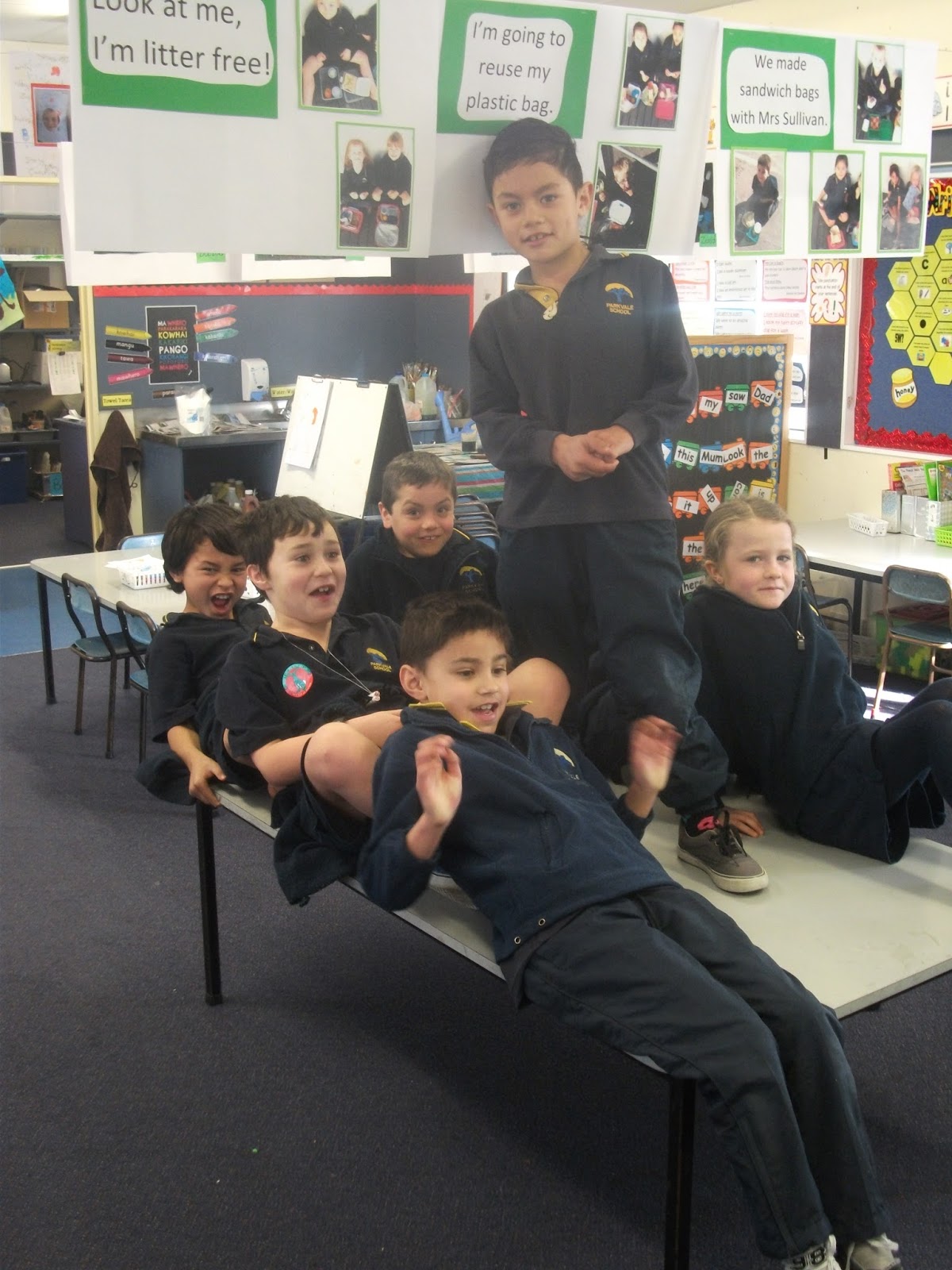


MUSIC - telling stories through waiata and with instruments


Subscribe to:
Posts (Atom)